
Best Chart Setups For Success
How to Get the Most Out of This Book

Thank you for accessing the book Best Chart Setups For Success. This book is designed for beginning, intermediate and advanced traders. The authors in this book are leading experts in trading the stock, options, futures and Forex markets.

As you read this book, you will be exposed to multiple strategies that have high probabilities of success and/or high profit. Most of the strategies in this book are divided into three sections:

There are thousands of dollars’ worth of trading tools, indicators, training and mentoring services, books and videos available at steeply discounted prices. In short, you will have all of the information you need to trade your new favorite strategy tomorrow. Some of the things you will learn in this book are:

At 52Patterns.com it is our sincere hope that you take away several strategies that you can use when you are done reading this book. You will also learn about markets that you currently don’t trade, and you will find out if they are suited to your trading personality.

Finally, make sure to subscribe to 52Patterns.com. We provide free eBooks, videos, reports and other publications for active traders. Cheers to your trading success!

Chapter
01

MYSTERIOUS PATTERN THAT APPEARS BEFORE BIG MOVES

In my youth, I used to love reading books and watching movies about pirates and buried treasure. Sooner or later, someone would discover the treasure map, leading to a wild adventure to find the buried treasure chest. In most of these swashbuckling tales, the location of the buried gold was marked with an “X” on the map.

How many times have you looked at a major move in a stock, and asked yourself “Wow, what if I had gotten in on that stock early? I would have made a killing!”

You look at the stock and rationalize why the stock moved. Maybe it was based on a strong earnings report. Maybe a new drug got approved, or there was a pending merger or acquisition. Regardless of what caused the move, many investors sit on the sidelines and watch the move happen without pulling the trigger. What if there was a way to find out exactly where to capture the lion’s share of a major stock move without guesswork?

Let’s take a look at Netflix (NFLX) in 2009
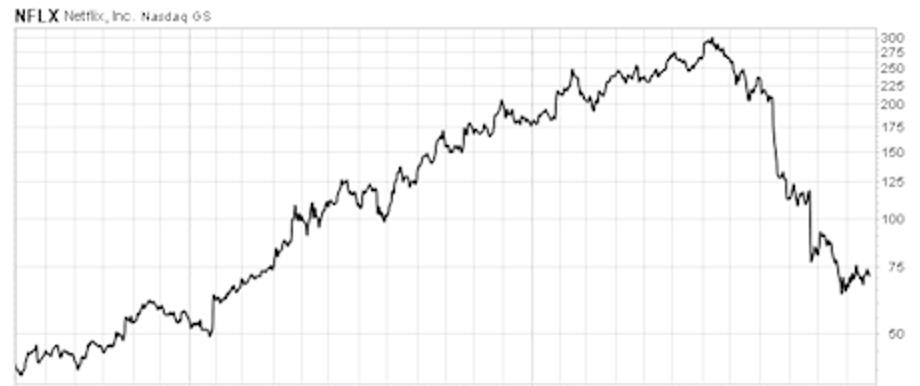
As you can see on this chart, NFLX grew from less than $50 per share to $300 over a 3-year period. That’s a 600% return on investment. A $5,000 investment in 100 shares of NFLX would have ballooned to $30,000.

What was the reason for this move and how many investors were able to capitalize on it? What if I told you that none of that really matters? What if the answer was as simple as finding an “X” on the charts?
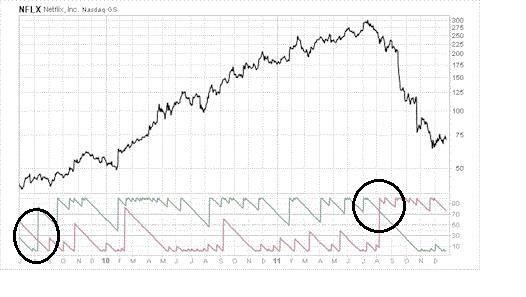
Look at the indicator at the bottom of the chart. On August 7, 2009 the green line shot up straight through the red line, forming an “X”. That is your signal to buy.

If you bought on August 7, 2009 you would have seen your investment grow 6-fold in two years.

On August 5, 2011, the red line broke up through the green line, forming another “X”. That is your signal to sell.

If you didn’t heed the 2nd “X”, the sell signal, you would have seen 65 percent of your gains erased.

Forget the fundamentals of the stock. Don’t worry about the news. None of this matters. Simply follow these rules:

  • “BUY” when the green line shoots up through the red line, forming an “X”
  • “SELL” when the red line shoots up through the green line, forming a second “X”

Let’s take a look at another example:
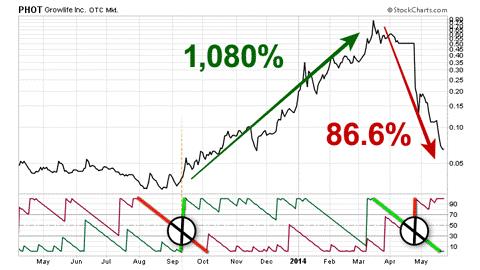
Growlife, Inc. (PHOT) is a tiny company that has emerged as a big player in the controversial, yet booming medical marijuana industry. The firm supplies medical marijuana growers with hydroponic equipment, lighting, nutrients, and even marketing for this rapidly expanding industry.

On September 11, 2013, the green line shot up through the red line forming the first “X”. Time to buy. Over the next 7 and a half months, an investment in PHOT gained 1,080%. A $1,000 investment in PHOT would have grown to $10,080 in just over 7 months.

Knowing when to exit a trade is just as important as knowing when to buy. On April 24, 2014, the redline shot up as the green line fell, forming the second “X”. Time to sell. If you decided to ignore the second “X”, you would have watched 86.6% of your gains erased.

Now, it's not hard to imagine what could've caused this jump in the price of Growlife. After all, it was a top story during that October and November.

Colorado and Washington were beginning to accept license applications to sell medical marijuana, and the U.S. Justice Department publicly announced they would not intervene in this formerly illegal industry in these two states.

This opened up the floodgates for a new legion of customers – all clamoring for Growlife's products.

And, thanks to this increasing popularity, during a late 2013 announcement, the company revealed its earnings had jumped 278% over the prior year.

How to pick Winners
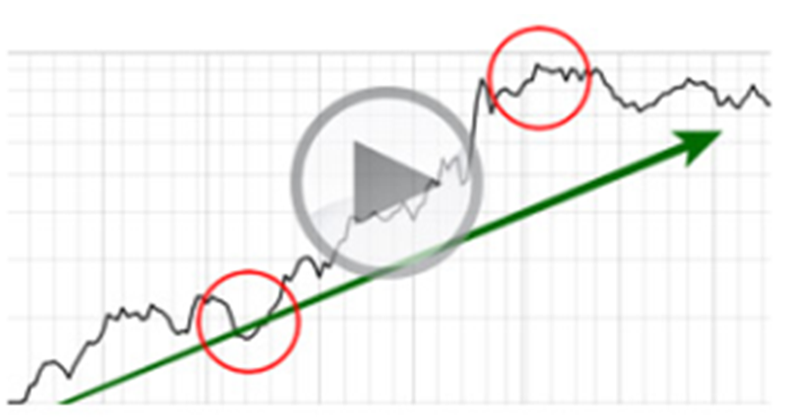
Discovery of Hidden X-Pattern: "You will, with 100% certainty, only buy stocks that are going up"

But none of that matters...

Growlife's stock had entered a state of high velocity before Colorado and Washington began accepting medical marijuana licenses. This state of high velocity also occurred before insider information about this company's financial successes became public knowledge.

So anybody waiting around for the news would've missed out on a good bit of those 1,080% gains.

And one final example, this time with a more conventional stock:
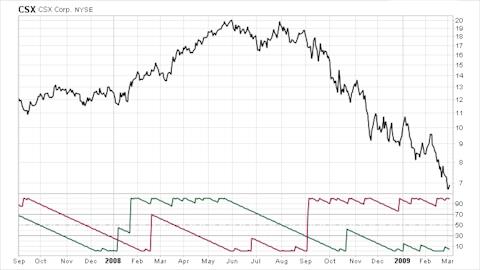
CSX Corp. (CSX), the railroad behemoth entered a phase of high momentum on January 7, 2008. The green line shot up through the red line, forming the first “X”. Time to buy.

CSX then shot up 45% over the next eight months. On September 3, the red line shot through the green green line, forming the second “X”. Time to sell. If you ignored this signal, you could have lost a considerable chunk of money.

So, how often does a stock form a BUY “X” Signal?

According to Keith FitzGerald, Chief Investment Strategist at Money Morning, based on a six-month investigation of winning trades , the first “X”, the “BUY” signal for a chart, has appeared on 2-3 stocks per month, every month, for the past 15 years.
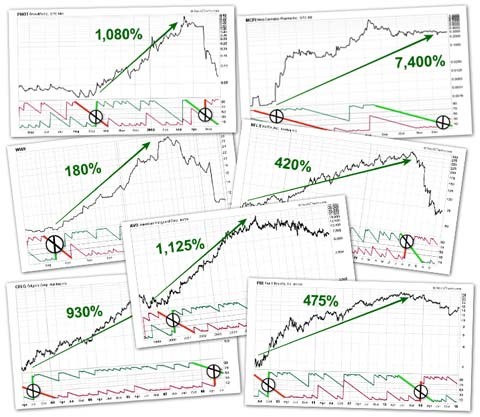
Take a look at even some of the most exceptional gains in the stock market. As you can see, it’s really as simple as buying on the first “X” and selling on the second “X”.

How does the Red and Green Indicator Work?

The secret behind the X all comes down to a formula...

Here it is.

  • You take the number of periods for the stock.
  • Next, you subtract the number of periods since that stock hit its highest high.
  • Then, you divide that by the number of periods again.
  • And finally, you multiply that answer by 100.

While that may seem like a mouthful, it is important for you to at least understand the big picture.

So two spots are marked "Number of Periods."

That's simply the adjustable window of time the formula uses to determine the strength of both momentum and gravity. To keep things simple, let's use 100 – meaning 100 days.

We're looking to find the right time frame to base a specific trade on.

Now, I've highlighted part of this formula labeled "Number of Periods Since Highest High."

What this represents is the number of days that have passed since this stock's share price reached its 100-day high point for the green momentum line.

Now, for the red line, it's the same formula – you are just calculating the number of days since this same stock's share price reached its 100-day lowest low point.

So after you crunch the numbers you take these scores and you create trend lines for both the green and red lines.

At two points these two lines will meet – meaning both forces are equal.

Then, at the first point, the green line will continue shooting straight up as the red line falls.

The first X will appear.

When they meet again – the red line will be the one rising, as the green line is falling.

Their paths will cross, creating the second X.

Just like you see here.

These two Xs generally signal a 48-hour window for when you should enter and exit a trade.

Conclusion

Just like the treasure maps in the pirate books, the charts can give the exact locations to find impressive, high velocity moves in almost any stock. When you see the first “X”, it’s time to buy. When the second “X” appears, it’s time to sell.

“X” marks the Spot!

THE MOVIE

Market Phenomena Revealed
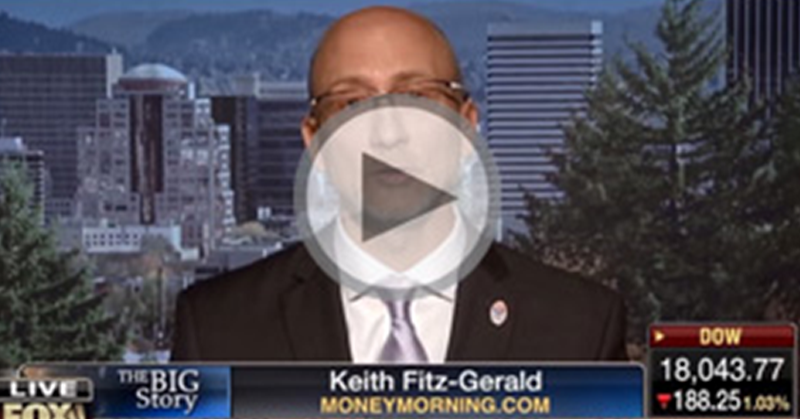
Wall street investment strategist discovers a mysterious "X-Patterns" in winning stocks

Keith Fitz-Gerald, Founder of“High Velocity Windfalls”, walks you through multiple examples of this simple, yet powerful strategy. At the end of the presentation you will have the opportunity to take a low cost special offer that will allow you to receive Keith’s invaluable research and start trading this strategy tomorrow!

THE SPECIAL OFFER
Chapter
02

$VIX Spike Peak Buy Signal

Lawrence McMillan, McMillanAsset.com

It is well-known to our subscribers and somewhat known to the trading public in general that a spike peak in $VIX is a buy signal for stocks. In fact, it goes farther than that – a volatility spike peak in any entity is a buy signal for that entity.

In this article, we're going to try to quantify such buy signals. This is being done partially to construct a trading system from them, but also to gain some more understanding as to just how important these signals are.

For example, there have been eight such signals in the past year; six were profitably closed; one was closed for a loss; and the eighth is open and highly profitable right now (having bought on April 19th when $SPX closed at 1555). Let’s begin with some examples of volatility spike peak buy signals, and then develop the trading system.

Spikes in $VIX

When the stock market sells off sharply, it is common (although not mandatory) for volatility measures to increase rapidly. This is generally due to the fact that traders and investors panic and begin to buy (out-of-the-money) puts as protection. They do this during the market decline, and they tend to overpay for the puts as protection, thus increasing the implied volatility of the options more and more rapidly as the market falls. I always liken this to waiting until your house is on fire to decide to buy fire insurance. It’s pretty expensive at that point. Likewise, put protection is expensive when the market is already locked in a rapid decline.

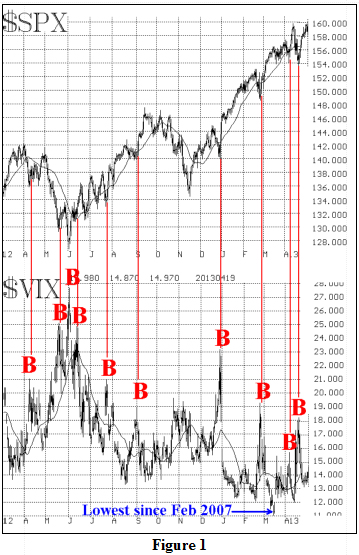
Eventually, though, the panic subsides, and volatility drops sharply. That forms a spike peak on the volatility chart, and is a buy signal for the underlying. Figure 1 on the right shows several such spikes in the CBOE’s volatility index ($VIX), where the “stock market” – as measured by the S&P 500 Index ($SPX) – would be considered to be the underlying. You can easily see that most of the volatility spikes, marked with “B” for “buy,” occur at or near short-term bottoms on the $SPX chart to the right.

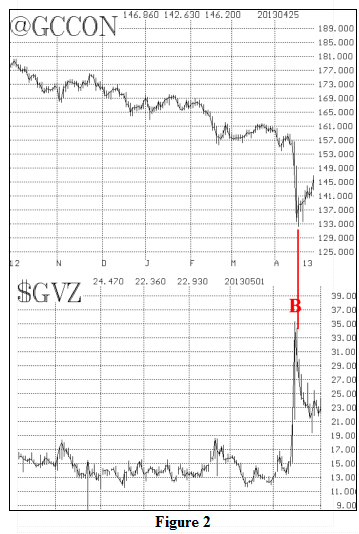
While we generally concentrate on $VIX and its buy signals for $SPX, the concept is useful in other markets as well. Consider Figure 2. It shows the “Gold VIX” (symbol: $GVZ, which is computed by applying the standard VIX formula to GLD – the Gold ETF – options). The “Gold VIX” is plotted underneath a chart of continuous Gold futures. One can see that the sharp decline in the price of gold about 3 weeks ago, caused a panic in the option market, with volatility ($GVZ) exploding to the upside. The peak in volatility occurred the day after the actual bottom in Gold futures (and in other Gold measures, such as GLD). A quick oversold rally ensued.

Often these spike peak buy signals are intermediate-term in nature, but sometimes they are merely evidence of an extremely oversold condition. As we explore the mechanics of these volatility spike peak buy signals, we’ll examine both short- and longer-term holding periods.

A $VIX Spike Peak Trading System

We will attempt to define exactly what constitutes a spike peak in $VIX, and how much of a reversal downward is necessary to generate the buy signal. Furthermore, we’ll address what to do when the signals don’t work out.

After years of observing $VIX, I have noticed that – whether $VIX is high-priced or low-priced – a sudden downward reversal of at least 3 points off of a peak is enough to constitute a buy signal.

I’m sure there are critics who will say that one needs to use a percentage distance for the reversal. But in doing so, a lot of signals can be missed. For example, suppose you said a 20% reversal is needed. Then you’d hardly get any signals when $VIX is above 40, for even at those levels, it doesn’t reverse downward by 8 points very often. Conversely, if you said only a 10% reversal is needed, then you’d have too many false signals at low levels for $VIX. And if you try to scale the percentage reversal required, you’d be moving towards my idea of just using a fixed constant at all times.

While I’m sure we could test many theoretical price moves to come up with the optimum one, I am definitely an opponent of optimization – especially if it differs from my own observations. Optimization produces wonderful back-tested results, but may not be so good going forward.

With that in mind, here is my “system” for trading $VIX spike peak buy signals. I should say that I created this from my past observations and, since it tested well, I did not feel it was necessary to test further scenarios. However, if anyone wants to, that would be fine with me.

  1. identify a sharply rising or “spiking” $VIX. For my purposes $VIX is “spiking” if it has increased 3 points over the last day, or over the last two days, or over the last three days, close to close. Thus, if $VIX closed at 13 today, then if it closes above 16 on any of the following three days, it would be in “spiking” mode.
  2. once $VIX is “spiking,” we look for a spike peak. In this mode, we keep track of the highest intraday price that has been reached. A spike peak occurs if $VIX closes any day at least three (3) points lower than the highest intraday price of the recent “spiking” sequence. $SPX is bought at that close.
  3. the system is stopped out if $VIX subsequently closes above the afore-mentioned highest intraday price.

We monitored the signals for 22 trading days, noting the gains or losses after 1 trading day, 3 days, 5 days, 10 days, and 22 days (approximately one trading month). If the signal is not stopped out, no new signal can arise even if it otherwise would have by the above rules. Once the 22 days had passed or the system was stopped out, only then was a new “spiking” status watched for.

As an example of a “stop out,” consider Figure 3, which shows a recently stopped out signal. At a) $VIX was spiking, having quickly rise from 12 to 17 in two days. A buy signal occurred at point b), when $VIX closed slightly more than 3 points below the “spiking” intraday high. But at point c) $VIX closed above the previous spiking high from point a). That was a “stop out,” and it automatically returned the system to seek for a “spiking” $VIX. It turns out that the close pointed to by c) was a “spiking” bar as well, because $VIX closed at 17.40 that day, more than three points higher than the close two days before, at point b). Hence, the system was immediately looking for another buy signal.

That buy signal was found the next day, at point d) as $VIX closed more than three points below the high of c). This, in fact, is the most recent buy signal and it is still open, having gotten long $SPX at the close of trading on April 18th (at $SPX 1555).

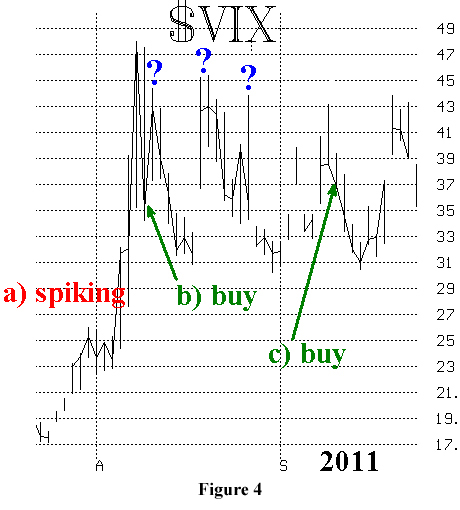
I would also like to clarify a statement I made earlier that, once a buy signal is in effect, no other buys are looked for, even though they might have occurred by the general rules. Figure 4 shows data from August-September of 2011. $VIX spiked at point a) and continued to blast higher, rising from 17 to 48, before finally closing more than 3 points below that at point b), That buy signal remained in effect for the entire 22 days since $VIX never rose above the intraday high at 48. Hence spike peaks obvious to the naked eye – marked with blue question marks – were not included as buy signals in the study since the system was already long. Eventually another buy occurred at point c), which came 23 trading days after the previous signal.

The results of the study are shown in Table 1, above. All profit results – rows with a “$” in the leftmost column – show points of $SPX profit or less, not U.S. Dollars. So, the yellow, highlighted figure in the rightmost column shows that the average trade made 12.3 $SPX points.

The column one should focus on is the rightmost one, labeled “Trade.” This includes the actual result of each trade, including all stops – at whatever point they may have occurred. Conversely, the other columns only have results if the open trade lasted that long. For example, there were 70 trades in total (39 wins and 31 losses). But there were only 37 trades that made it through the entire 22 days without being stopped out (31 wins and 6 losses). Note these numbers in the above table in rows 2 and 3 of the last two columns.

The worst loss was 96.9 $SPX points. That occurred in January of 2009. There was a buy signal given, but the stock market turned and headed lower (eventually bottoming in March, 2009, for good). $VIX never rose much during that decline and hence the system was never stopped out by a higher spike in $VIX.

The biggest gain was 137.2 points coming out of the October 2011 bottom. Note that the maximum gain and loss for one day are both surprisingly large. There was a 103.8 gain in $SPX in one day in October 2008. The worst one-day loss occurred in August, 2011. $SPX lost 79.9 points on the Monday after Moody’s downgraded U.S debt, and the system was long going into that day.

I think this proves what we have known all along – that $VIX spike peak buy signals are excellent entry points for buyers. Many of these occurred in times of high panic, of course, and it may not have been easy to actually buy the market at that time, but it should have been done, nevertheless.

Using Options

These results do not show how one would have done with options, instead of merely buying “$SPX.” Clearly, an option trade could be profitable if $SPX rises 12 points in a month, although we are talking about $SPX options here – not SPY options. So, when $VIX is high, the time value premium of an at-the-money, one month $SPX option could be more than 12 points.

In Table 1, the average win was 49 $SPX points, and the average loss was 33.9 $SPX points. So, if one had bought an at-the-money call on each buy signal, that call would not normally have cost 49 points. For example, at the current time, an $SPX June (7th) 1625 call costs about 19. But during times of very high implied volatility, the call could cost more than 49.

In addition, with options, the large losses would have been avoided. The large losses noted earlier were 96.9 $SPX points in early 2009 and 79.9 points in August 2011. Clearly being long a call option would have had limited losses during those large declines.

Table 2, above shows the statistics for buying a one-month, at-the-money $SPX call (at the prevailing volatility) and selling at the same times as noted above (including stops). Table 2 is comparable to the rightmost column in Table 1.

The rate of return is much higher with the options. The average profit was 6.4 points (just a little more than half of the average profit of 12.3 points in Table 1), but the investment was much smaller, as the average option upon entry cost 37.6 points. Hence the average ROI was 16.9% on the option trade, as opposed to about 1% for the $SPX trade.

The maximum gain did not occur in October 2011 as it did in Table 1. Rather, it occurred in July-August 2009, when options were cheaper to buy. The $SPX call was bought for 31 and sold for about 125 – a gain of almost 94 points at that time. The max loss of –44.8 points came in January 2009, as it did in Table 1.

Hence, the option approach is better, and now that we have a formal system, we will use it more specifically in the future, rather than just saying “$VIX gave a buy.” Similar returns should be achievable with SPY calls, although commission costs might be larger.

THE SPECIAL OFFER

Get a free 30-day trial to my flagship advisory service, The Option Strategist Newsletter.

Scroll to the bottom, click the “ADD TO CART” button ($28.75) and enter the Coupon Code TPFREE at checkout. No credit card is required. Subscription will not automatically renew upon completion.

ABOUT THE AUTHOR

Lawrence G. McMillan is the President of McMillan Asset Management and McMillan Analysis Corporation, which he founded in 1991. He is perhaps most well-known as the author of Options As a Strategic Investment, the best-selling work on stock and index options strategies. The book – initially published in 1980 – is currently in its fifth edition and is a staple on the desks of many professional option traders.

His career has taken two simultaneous paths – one as a professional trader and money manager, and the other as an educator and proponent of using option strategies.

In these capacities, he currently authors and publishes "The Option Strategist", a derivative products newsletter covering options and futures, now in its 24th year of publication. His firm also edits and publishes three daily newsletters, as well as option letters for Dow Jones. He has spoken on option strategies at many seminars and colloquia, and also occasionally writes for and is quoted in financial publications regarding option trading.

Mr. McMillan is the recipient of the prestigious Sullivan Award for 2011, awarded by the Options Industry Council in recognition of his contributions to the Options Industry.

Chapter
03

The Equality Trade Using Elliott, Fibonacci and Harmonics

By Jody Samuels, FXTradersEdge.com

The Equality Trade is a chart setup that uses the convergence of Elliott , Fibonacci and Harmonics to identify precise trade entries and exits.

When I look back over my 30+ year trading career, I can’t point a single time where I didn’t use Elliott waves in my analysis of the markets. In fact, I won’t trade without it.

In this video, I will share my knowledge and passion for Elliott waves, and then I am going to mix in Fibonacci and harmonics to show you the power of the Equality Trade.

THE MOVIE

THE SPECIAL OFFER

ABOUT THE AUTHOR

Jody Samuels is one of North America’s leading coaches for successful traders, and the creator of The FX Trader’s EDGE™ Program. She works with members of her program in group and private coaching sessions and is passionate about teaching individuals how to trade the market cycles and use entrepreneurial skills and habits to effectively manage their businesses.

Jody Samuels, a professional trader with 15 years’ experience trading currencies with a New York international investment bank, successfully made millions of dollars using the proven theories of Elliott Wave analysis. The Elliott Wave Ultimate Course, Jody’s latest accomplishment, illustrates the convergence of Elliott, Fibonacci and Harmonics in a ground breaking program to combine precise analysis with a simple strategy.

Chapter
04

Active Zone and Dead Zone Trading

By Joshua Martinez, MarketTraders.com

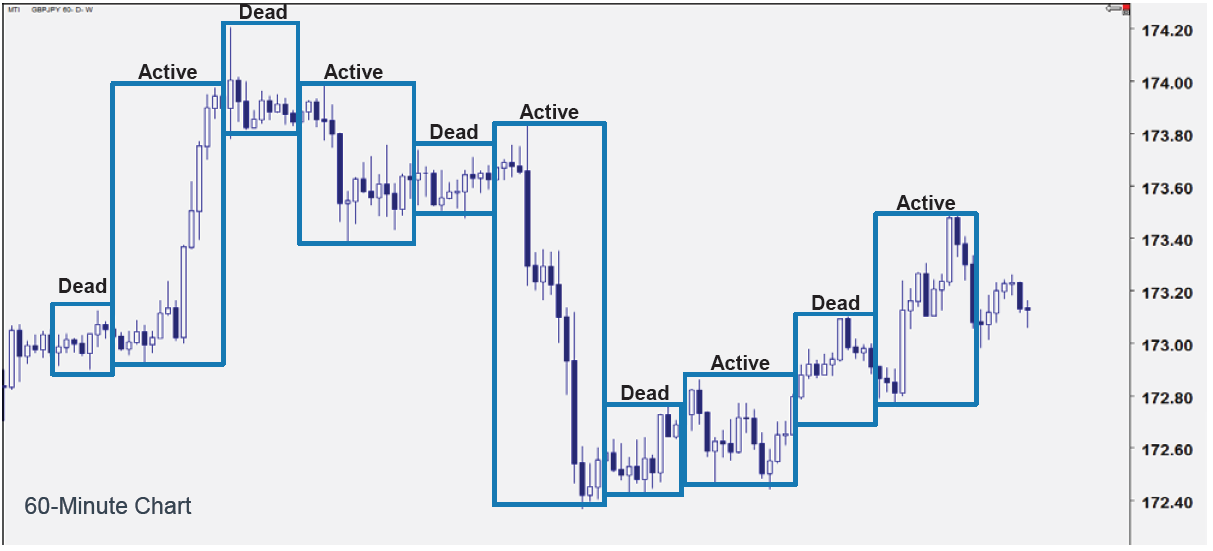
The Active zone takes place between 2:00 am and 12:00 pm ET the Dead Zone follows from 12:00 pm to 2:00 am ET. Using these two zones you can judge when it could be a good time to enter into a trade and when to stay out of the market.

In the Active Zone you have the most directional movement of the day this is where you will see the low to high and high to low pushes. In the the Dead Zone you will see more sideways movement.

The Active Zone is shown below making high low to the high/high to low movements along side the choppiness of the Dead Zone.

img1

For example the GBP/NZD is on it’s way towards a D extension at 7:00 pm EDT and you have 70 pips left, more than likely from 7:00 pm to 2:00 am the market will drift bearish towards the D extension and at 2:00 am it will hit the D extension and the next day the market will run bullish (fast and aggressive). During the Dead Zone it took 7 hours (7:00 pm to 2:00 am) for the market to hit the D extension however during the Active Zone it would take 3 hours to cover the same distance in the market.

Presentation

So what causes this to happen?

The zones are created by volume and directional movements stemming from the 3 major trading sessions.

  • At 5:00 PM ET - 7:00 AM ET, The Asian Session opens. It includes Japan, China, Asia and the pacific rim of New Zealand and Australia.
  • At 3:00 AM ET – 11:00 AM ET the European Session opens. It overlaps Asia from 3:00 AM ET – 7:00 AM ET.
  • At 8:00 AM ET – 5:00 PM ET, The US Session opens and overlaps Europe from 8:00 AM ET – 11:00 AM ET

The majority of directional Forex transactions take place during the European session. When the Euro session opens the banks begin to process bulk transactions which causes a push in the market creating the Active Zone.

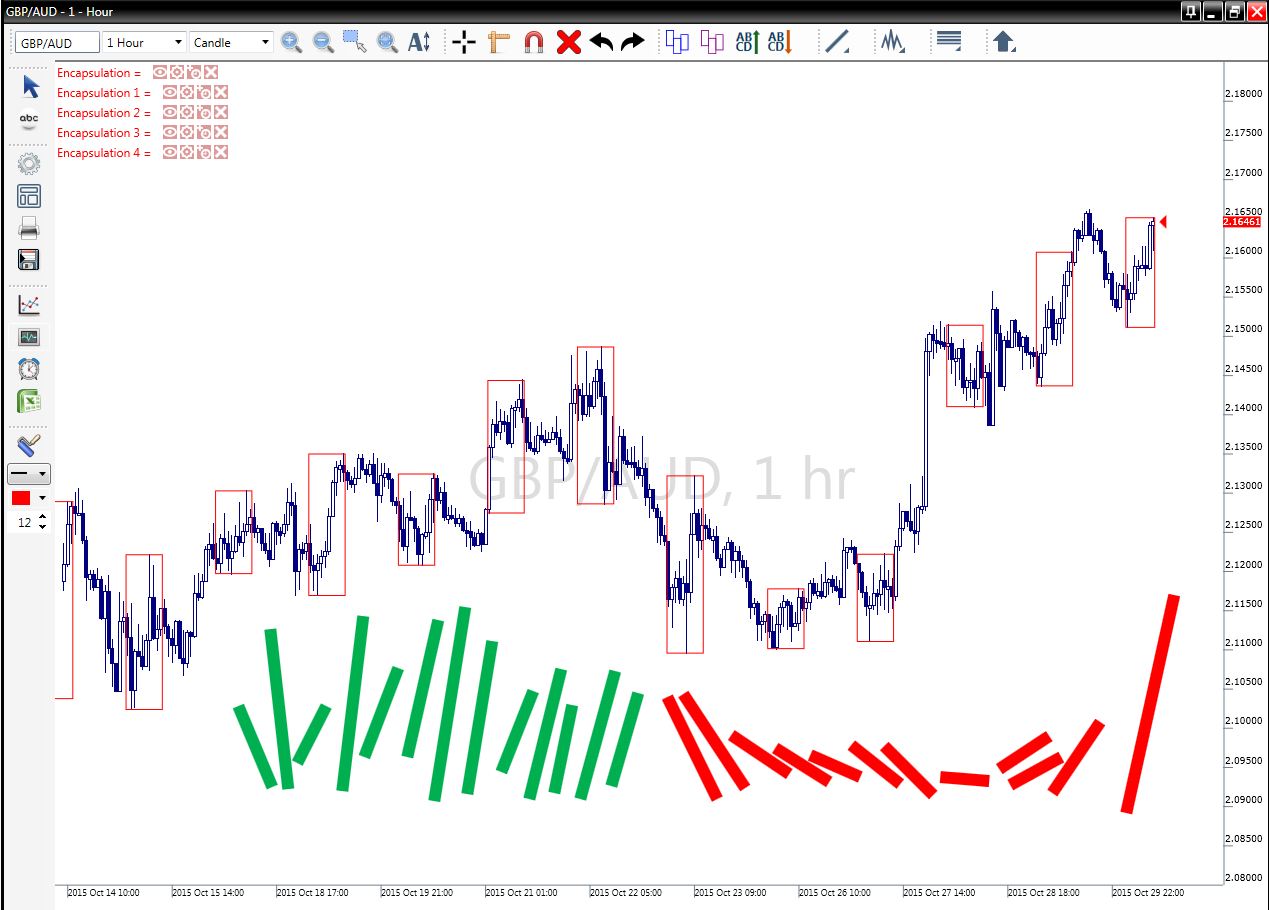
img2

Image 2 shows the Active Zone in green and the Dead Zone in red. The movements shown green illustrate the volatility that takes place in the Active Zone as compared to the sideways movement in the Dead Zone.

During the 4 hour window when the European and US session are overlapping one another (8:00 am to 12:00 pm) you are going to see a lot of volatility from the large volume of transactions taking place.

img3

Image 3 shows the green and red markers from the previous image. In this side by side comparison you can see how steep the Active Zone movements are compared to the the Dead Zone.

When the European session ends at 12:00 pm ET leading into the Dead Zone we begin to see that the volume and directional movements are beginning to enter a pull back.

img

With this information and knowing when to expect the volatility you have the advantage of planning your trading day and knowing when to stay out of the market. 

Best currency pairs to use for this?

EUR/AUD

EUR/CAD

EUR/CHF

EUR/GBP

EUR/JPY

EUR/NOK

EUR/NZD

What type of trader would this be best for?

Trading during the Active and Dead Zones is perfect for the type of trader that is looking for immediate profits up front. Scalper,Swing, Intra and Day traders would benefit from the higher volatility.

Beginning traders will love this because it is important to having winning trades when they are first starting out which will provide the confidence needed to take the next step in their trading career.

Position traders would not typically trade off of the Active and Dead Zones seeing as they will not be concerned about the drawn down and will hold a negative position for a month and then look to be positive in their trade.

Conclusion

The Active Zone is faster, you can time your trade from it, you can judge whether you have a push up or down as well have higher confidence in your trades. Several automated trading systems work well in this zone as opposed to the Dead Zone.

The Dead Zone is where you will see false signals, you are holding much longer trades and it is not as accurate.

THE SPECIAL OFFER

ABOUT THE AUTHOR

Joshua Martinez is Market Traders Institute's product expert and has trained thousands of investors to trade the Forex market. Joshua initially began his trading career with a $500 investment which he turned into over $39,000 in profit. He is a published author, professional FX analyst and most importantly he is a full time trader.

Joshua is one of MTI’s most followed Forex analysts and is head of MTI’s Analyst on Demand. His time is spent training and coordinating its’ team of analysts as well as monitoring and evaluating the overall trader experience for quality assurance. You can find him in the Analyst on Demand chat room sharing his trading insight to MTI Clients.

Chapter
05

The Best Pattern for Getting Aboard Existing Stock (And Other Market) Trends

Dave Landry, DaveLandry.com

Trading is all about money management and psychology. My methods for trading the markets uses technical analysis to gauge the psychology of the market.

A few key things you will learn about my approach to trading the markets is that my methods are:

  • Conceptually Correct Based On Market Psychology
  • Repeatable
  • Fully Disclosed
  • Money Management Is Crucial And Cannot Be Separated From The Methodology
  • Developing The Proper Mentality And Having The Proper Mindset To Execute The Plan Is Key

There is no Holy Grail to trading. In this video, we will keep it simple and strip away the indicators. You will also learn one of my favorite setups, “The Trend Kockout (TKO)”.

THE MOVIE

THE SPECIAL OFFER

ABOUT THE AUTHOR

Dave Landry has been actively trading the markets since the early 90s. In 1995 he founded Sentive Trading, LLC--a trading and consulting firm. He is author of Dave Landry on Swing Trading (2000), Dave Landry’s 10 Best Swing Trading Patterns & Strategies (2003), and The Layman’s Guide to Trading Stocks (2010).

He has been publishing daily web based commentary on technical trading since 1997, and has spoken at trading conferences both nationally and internationally. He has a B.S. in Computer Science and an MBA. He was registered Commodity Trading Advisor (CTA) from 1995 to 2009. He is a member of the American Association of Professional Technical Analysts.

Chapter
06

Using Momentum Flow Breakouts in Your Trading

Larry Gaines, PowerCycleTrading.com

Trading, in my opinion, is 99 percent direction, and in this video, I’m going to share the directional trading formula that I use for all of my directional trades.

To do this we are going to take a closer look at:

  • Trend Line Breakouts
  • Fractal Trading Analysis and its Importance
  • Predicting Price Direction
  • Best Momentum and Cycle Indicators
  • Best Trade Setups for Trading Success
  • Bringing All of These Elements Together

THE MOVIE

THE SPECIAL OFFER

  • On-Demand Course: 5+ Hour "How to Harness Momentum Flows for All Your Directional Trading"
  • Recording & 141 page Course Training Manual
  • PCT Dynamic Directional Trading System (Full Suite of Trading Software)
  • Follow Up Live Q&A

ABOUT THE AUTHOR

Larry Gaines has become one of the leading coaches for successful traders and investors. He continues to develop and host, every month, new trading educational programs to help traders and investors generate greater income from their investment capital with less risk exposure.

He founded PowerCycleTrading.com and the Power Cycle Virtual Trading Room following over 30 years of professional trading experience in the commodity and equity markets.

During his tenure as head of an international trading company that often traded a billion dollars worth of commodities in a single day, he learned first-hand the necessary elements of a successful trading system and the use of options.

Using this in-depth knowledge and experience, Larry developed the Power Cycle Trading™ Model to allow for greater profits with a more disciplined, systematic degree of trading success.

Chapter
07

How Market Internals Can Help You Read the Market

By Joanna White, CapitalDiscussions.com

Market Internals can be used to give you an overall feel of the market direction. The market internals are similar to a compass or the instrument panel on your car. The internals can give you a sense of the speed and direction of the market. The internals can give you the overall strength or weakness in the market. This can help you determine if you are neutral, bullish or bearish. Then you can plan your trades according to your market bias. The internals are used for the most part for the equities markets. There are several market internals which can be tracked and this article is based on the NYSS.

Up Volume vs. Down Volume Chart or Breadth Chart

image1

The first chart to set up in your grid is the $UVOL-$DVOL 15 minute chart. This chart allows you to see the breadth of the market. $UVOL-$DVOL measures the amount of volume moving into stocks which are increasing in value to the amount of volume moving into stocks which are decreasing in value.

You can get a sense of the market by looking at the ratio of the $UVOL-$DVOL. If the ratio is plus 2 to 1 or greater, the market could be considered to be bullish. If the ratio is negative 2 to 1 or greater, the market could be considered to be bearish.

Advance Decline Line or AD Line

The $ADVN-$DECN or advance-decline(AD) line is the next chart to set up in your grid. It tracks the NYSE. Use the 15 minute time frame for this chart. The advance-decline line chart looks at the difference between the number of stocks which are advancing minus the number of stocks which are declining.

When the price action is hovering around the zero line on the AD chart it usually shows a market with very little confidence.

A strong reading on the AD line chart is usually above the 800 or 900 level. Extreme readings are around the 2000 area. Reversion to the mean days will be around the plus or minus 500 area and the price action will be oscillating above and below the zero line.

If the chart level reaches the plus 1500 area, the market can be considered to be bullish. If the chart level reaches plus 2000, the market can be considered to be very bullish.

If the chart level reaches the negative 1500 area the market can be considered to be bearish. If the chart level reaches negative 2000, the market is considered to be very bearish.

The TICK Chart

This chart tells you how many stocks are trading on an uptick verses the number of stocks trading on a downtick at the exchange level. This tick chart is looking at the NYSE. Many traders use either the 5 or 15-minute chart. Some important levels on the chart to consider are the plus 800, the plus 1000, the negative 800 and the negative 1000.

The tick chart many times is used to gauge very short term market extremes. The tick chart readings usually range between the plus 700 to plus 800 to minus 700 to minus 800. When you see plus or minus 1000 on the tick chart, this can be considered to be a large extreme. Usually, these large extremes signal a short term reversal may be coming. Many times day traders will use these extremes to see when a short-term market reversal may occur. Some say the tick chart is one of the most important tools for day traders.

Tips to Read the Tick Chart

The tick chart for some day traders is very important. The tick chart can affirm or deny how a trade progresses before or after you enter a trade. You can use the tick chart to monitor your trade.

On strong trending days the tick chart will read plus or minus 1000 multiple times. The tick chart is the fastest of the three market internals.

To get a feel for the tick readings look at the body of the candle to see if most or all the candle is above the zero line or below. This will give you a sense of the market. If the candle bodies are mostly above the zero line it can signal a bullish bias. The opposite can signal a bearish bias.

The 5 or 15 Minute Price Chart

When you set up the price chart of the underlying market many use ES; some use SPY, SPX, etc… Many traders use a 5-minute chart or a 15-minute chart. I like to use the 21 EMA. Some use pivot points on their price charts. Set up the indicators, moving averages, etc to whatever parameters allow you to read the price action on a chart. What makes you comfortable is best.

The Internals Can Help You Confirm Your Trading Decisions

By evaluating the internals using convergence and divergence, you can create a market opinion. When you see changes happening in the price of the underlying that are not evident on one or more of the market internals, such as the advance-decline line or the tick chart, this could be a signal of divergence.

If you are evaluating a directional bullish position, you most probably want the market internals to be bullish. If you are bearish on the market and want to make a directional play, you most probably would want the market internals to be bearish. The internals can help you to confirm your decision.

If you are the type of trader who does not like watching charts throughout the day, you can get a sense of the general market by looking at the internals. The internals can give you a quick overall synopsis of the market, which can be a large time saver.

Market Context and the Internals

When you use the internals it is important to reference the price action on the price chart of the underlying(s) you are trading. By looking at the longer term highs and lows, previous day highs and lows, pivot points, channels, congestion, swing highs and swing lows etc., you can then relate the internals to your overall market outlook.

A choppy market can be reflected in the breadth which is the $UVOL-$DVOL chart. If the ratio reading on the breadth chart starts with a 1, the market is choppy and not trending. Price action will be ranging close to the zero line on a choppy day.

When you have a trending market the breadth ratio will generally get above the 2 to 1 ratio.

Reading the Internals is an Art and not a Science…

Learning to read the internals takes a lot of practice. Understanding the internals is an art and not a science. It will most probably take you some time to learn, but it could well be worth the time invested. You can use the internals to look at the overall market to gain a general bias of the markets. Or you as a day trader can learn the signals provided by reading the internals to guide you in your trading. Use your edge and use the internals to be a consistently profitable trader.

Backtesting – Is it Worth Your Time?

I think we can agree that understanding market internals can be a significant aid in helping you decide when and how you may want to enter and exit a trade.  But, it takes practice and “feel” to gain a real appreciation for how market internals can be best put to use. For this reason, I cannot emphasize enough how important it is to backtest  any new trading idea or recommendation before you risk real capital.

Some traders are of the mindset of “what good is backtesting if it doesn’t always replicate real-life trading?”

It’s true that backtesting isn’t the same as live trading. It doesn’t recreate all the emotions and the market conditions such as low-volume days when you just can’t get a decent fill, news events that can cause erratic market behavior intra-day, etc. However, what backtesting does do is to allow you to keep trading a workable trade during a period of draw-downs and be confident that overall, the trade is profitable. backtesting gives you a track record that instills confidence in your trade plan.

What else does backtesting do for you?

  • Backtesting could keep you from abandoning your trade plan.
  • Backtesting could help you from over-adjusting because your testing results confirm your adjustments as planned have a higher probability to work as intended.
  • Backtesting could prevent you from jumping around from one trade to another.
  • Backtesting could give you confidence in a new trade strategy, or in an existing strategy when considering increasing the size of the position.
  • Backtesting could minimize the paralyzing insecurity that sometimes accompanies the switch from paper trades to live trading.

What if you don’t have backtesting capabilities?

If you don’t have backtesting capabilities, almost all brokerage platforms allow you to reset certain parameters in your trade or a simulated trade setup looking. This allows you as a trader to look at possible future results you may encounter as the trade matures. This may include rolling implied volatilities up or down, changing the date, or changing the price. If you are a trader without backtesting capabilities, you could test your trades in this manner if your platform has the capability to determine how it might act theoretically in certain market conditions looking into the future. You could follow a trade through each expiration cycle on a simulated basis. You as a trader could also simulate several expiration cycles, always pre-testing how certain adjustments might work. Then these simulated adjustments can be monitored with your live position to determine if they worked as predicted in your simulation.

So, how does your backtesting and simulating trades relate to live trading?

Don’t underestimate the importance of your trading style and confidence level when evaluating a back-tested trade. A good result of your back-test can make your trade plan mechanical, as much as possible. By becoming more mechanical due to your backtesting, your experience will allow you to act as your trade plan dictates, making the necessary adjustments to your trade at the proper moments.

You can’t replicate all the hurdles of live trading with either backtesting or forward-testing, but it all helps. It’s about building confidence in your trade. Your confidence can help you follow your trade plan and guidelines. This confidence can allow you to enter, make appropriate adjustments if needed and exit your trade as planned in your live position.

The quote below can be related to the benefits of backtesting:

“Your primary goal has to be to learn how to think like a consistently successful trader. Remember, the best traders think in a number of unique ways. They have acquired a mental structure that allows them to trade without fear and, at the same time, keeps them from becoming reckless and committing fear-based errors.”Mark Douglas

In summary, whether you have a backtesting program or use your broker’s simulated trade capabilities, test, test, test. Test a lot. Testing can help identify potential pitfalls and potholes. However, it’s important to be aware that when you’re ready to make the switch to live trading, that testing can act somewhat like sunlight on rain-slicked roads. All that shiny sunlight can bounce off the water, covering a pothole that can cause you to veer off course. Don’t speed into live trades too quickly; drive carefully until you’re feeling certain of the surface beneath you.

THE SPECIAL OFFER

ABOUT THE AUTHOR

Joanna White has been trading options full time for income for 9 years, and resides in the US. After a diverse career in marketing and sales management, she chose trading as her full time career.

Several books have inspired Joanna along the way; "Reminiscences of a Stock Operator" by Edwin Lefevre being the most memorable. This fascinating story of the legendary Jesse Livermore was truly inspirational in confirming her decision to pursue trading as a career. Joanna believes the psychology of trading is equally important as the technical aspect. The book "Trading in the Zone" by Mark Douglas helped Joanna gain the discipline and confidence necessary to become a successful trader.

Joanna primarily trades non-directional, positive theta trades such as Iron Condors and Butterflies. Her trade plan consists of a combination of monthly and weekly trades.

Risk management is of the utmost importance to Joanna. She looks to take smaller, consistent gains and control losses carefully to achieve her annual income goals.